Pages

Wednesday, 12 October 2011

Goa - A new face


Goa shows different faces to different people.

It is beaches to foreigners. To some Indians it is temples or churches.  To some others it could be fish curry and rice. And before you say I am forgetting something, which I won't, it could also be Feni - Goan liquor made out of coconut or cashew.

Goa is surely different than other states. When young, I often heard that it was one of the safest places where people did not lock their doors. And windows, often circular in shape, had no grills. But I don't mean this, when I say different. It is the mood in the air. Visiting is believing.

I have visited Goa many times both on official duties as well as in personal capacity. On this occasion, apart from the official responsibilities, I also decided to explore the Goan Nature. My free time permitted me one of the reserved forests and my other interest was the only bird sanctuary in Goa that is Dr Salim Ali Bird Sanctuary.


I decided to visit Bondla wildlife sanctuary on a late afternoon. The timing was not ideal for such a visit but I had no choice as the other free slot. the next day morning was reserved for Dr Salim Ali Bird Sanctuary near Panaji. Bondla WS is about 35 Kms from Margaon . . .मडगाव् in Goan official language Konkani - कोंकणी.

Incidentally, Konkani is my mother tongue too and is spoken by another 3 million + population on about 800 Km stretch of west coast of india.  

The Spotted deer and the Great Malabar Squirrel in the Bondla WS, both of whom waited until I clicked their pictures were my achievements of about one hour that I spent there.  


When I had made enquiries about Dr Salim Ali Bird Sanctuary I was informed that the migratory birds were yet to arrive. But Nature always has surprises and my visit to the sanctuary next morning was a good experience. My journey to Chorao island across Ribandar, Panaji where the sanctuary is located also gave me a glimpse of Goan life.

Most of people residing on Chorao island need to take a ferry every day to reach their working places on the main land. I just imagined myself doing that every day. But I later wondered as to the shock a Goan would have if they see the rat race we  Mumbaikars go through every day to reach their office places.

Following picture is a sight of main land as seen from Chorao island. The ferry crosses Mandovi river in about 15 minutes. There is a charge only for the vehicles. The BS is just there on landing on the island.


This sanctuary is full of mangroves and it was a wonderful experience of walking through the sanctuary. Unlike many other bird sanctuaries, it is necessary here to take a fixed route which is paved by concrete blocks  and return the same way. Did not see much of bird life and the picture below was a typical view during the walk.


Though I could hear many bird calls, only birds seen were the waders in a few places. I have always seen these waders doing what they are best at - wading. here I found them sitting on branches of the trees.
Whimbrel (Numenius phaeopus)

Common Redshank (Tringa totanus)


When I completed my tour of the sanctuary in about an hour and came out, a friendly local Goan offered me to take me in his canoe in the Mandovi river with a promise of many more waders. But on seeing the type of canoe that I was to travel with my precious camera, I did not dare. But he had also an alternative suggestion at the cost of loosing his own business - walk along the Mandovi river on the opposite side of the sanctuary and there he assured, was a lot of bird life.

His advice turned out to be good and here are some pictures taken out side the sanctuary on the same island:


This is the most common wader we see in all the places but I am never tired of snapping them on my camera whenever it is seen in such natural surroundings.
Greater Egret (Casmerodius albus )

My biggest surprise on this tour was the variety of butterflies . . . both inside and outside the sanctuary. Unfortunately I do not know their common names, leave alone the scientific names. I will surely update this blog when some of butterfly experts - I think they are called Lepidopterist help me.

Grey Pansy


Danaid eggfly

Chocolate Pansy


Thought this commonly seen butterfly is not the most exotic of the species, I often become nostalgic when I see one. I grew with them in Mumbai and in those school days we often caught them. More than catching them we were interested in seeing the yellow colour that its wings left on our fingers. 

Grassy Yellow


I have a special place for this butterfly with damaged wings. When I posted earlier a similar injured butterfly my good friend Ajith promptly send me this link : Repair a Butterfly

I wish this butterfly too gets this medical assistance. And soon enough.

Peacock Pansy


This female Indian Koel was sitting in a bush at the end of my Chorao tour.

Asian Koel (Eudynamys scolopaceus)


I was also amused at this bird. This night heron was sitting in the same place near the landing of the ferry. The bird was still there after more than 2 hours of my Chorao tour and in fact it bid adieu in his own style with a comic face. Please see it for your self.
 

Night Heron (Nycticorax nycticorax)

Small Blue Kingfisher (Alcedo atthis) with Common Sandpiper (Actitis hypoleucos)


Though, churches were not my focus on this Goan tour, one can not miss them anywhere one goes and when I happened to pass through Old Goa, I did stop and took some pictures. One of them is now converted into an archeological museum.


Business side of Goa also went well. But I still have some unfinished work here that will bring me back soon. Very soon.

Saturday, 8 October 2011

Plateau of Flowers


Kaas plateau or Kaas Pathaar in Marathi is the place to be during flowering season. The season lasts just for a few weeks at the end of south-west monsoon during which the plateau dons a different look. Kaas is about 25Kms from Satara in Maharashtra and about 300Kms from Mumbai.


It is something odd about this place and that perhaps is the the reason why Kaas was not known to many until recent years. I dare say that there is nothing beyond Kaas...literally. Once on Kaas road, one does not see any roadsigns to any known towns.

The road guide to Kaas was simple. I say this with confidence because I had Deepak for company and he was carrying a small guide that took us straight atop Kaas Pathar without an error. Many of you know Deepak, a blogger and familiar name through his travel blogs on Magictravels and MagicEye. On reaching the main circle in Satara which has both miniature Eiffel tower and a Shivaji statue, we kept to the left for another kilometer or two until we reached a Y fork with a tunnel entrance at about 30 meters on the left diversion. I was about to take the tunnel road when Deepak instructed me to take to right and very soon the road started climbing towards our destination. Later Deepak informed me that there was another popular spot - Thosegar waterfalls if we had taken the tunnel. There is also Sajjangadh fort close by for those spititually and historically minded. But for us it was Kaas, Kaas and Kaas.

Once we left Satara on this fine sunny Sunday, we forgot to keep track of the distance travelled and soon enough, we felt we were already there as we started seeing small groups deep into their study of some insignificant looking bushes and crevices. I wondered whether this is what we travelled 300 Kms for !  Here was one such students' group.


But soon the traffic pattern changed and started competing with worst road jams of Mumbai.  Sunday  was actually meant to be our reconnaissance visit but after overcoming the torturous traffic, we still managed about 2-3 hours amidst flowers before the sun set. 

We even spent some time at Kaas lake - Kaas Talav which was downhill about 2 Kms on the other side of the Plateau. A very peaceful place indeed !


A roadside 'fast food' place near the lake offered 'Dabeli' which I ate for the first time before returning to the flowers. Our immediate task was to find a parking space. There was enough police vigilance that did not allow any parking on the plateau itself and we were directed to a parking area about fifteen minutes away by walk. We parked the car and joined the 'pilgrims' in their walk to the plateau.

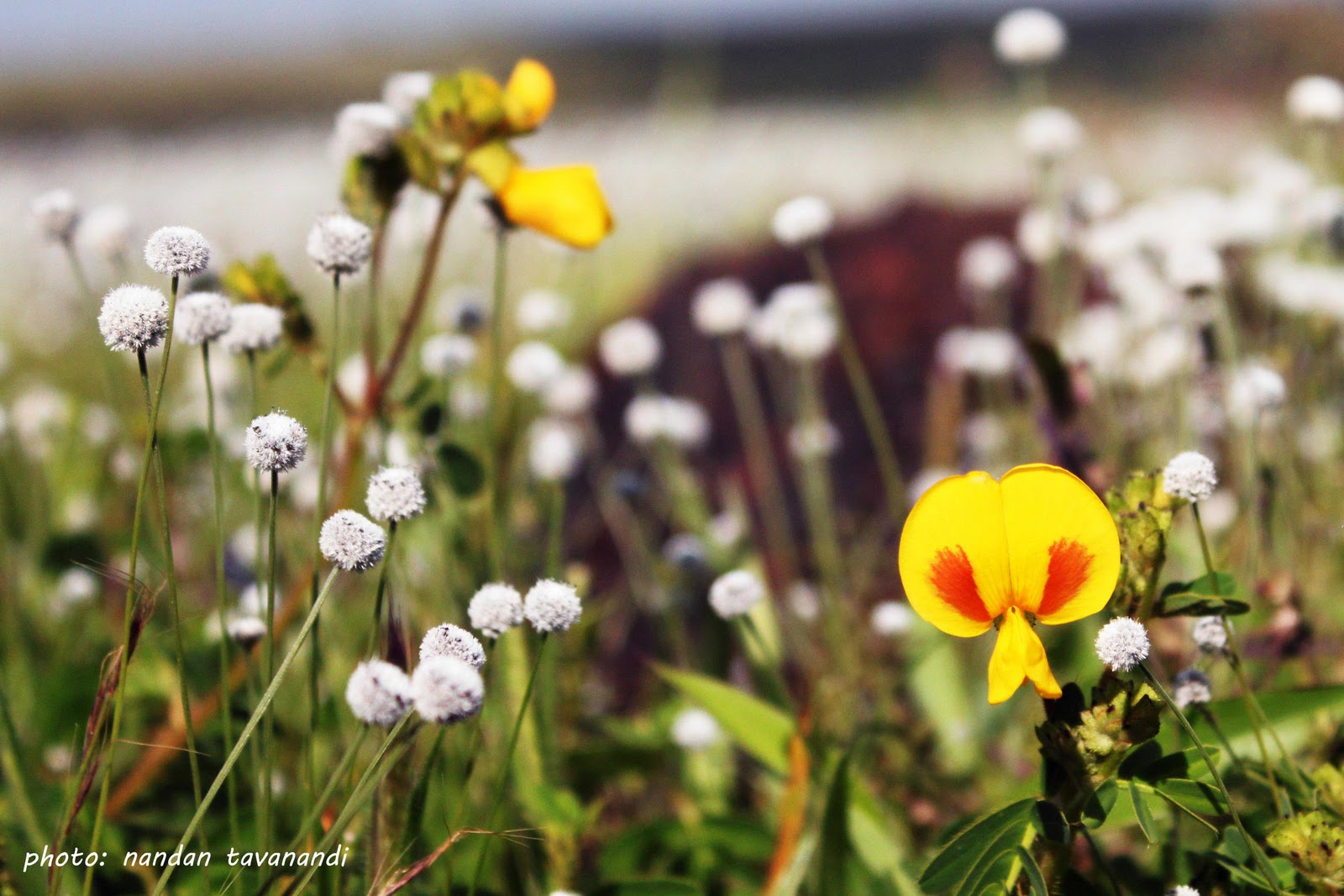
The plateau of Kass is home to millions of flowers - tiny in size and I read that more than 300 varieties of wild flowers, shrubs,plants etc. could be seen here. We were attracted to the place more with photography interest than botany in mind. As I am writing this blog, I am promising myself  to visit this place to pursue botany which I had left more than 3 decades ago. Will that day come with so many other beautiful spots beckning elsewhere in the country? For now, let us enjoy the colours :


From the north end to the south, the plateau stretches just over 1 Km and it abruptly descends into a steep valley beyond the plateau. What is seen in the following picture is the traffic on the road that splits the plateau.


Our Sunday sight seeing came to an end with this picture of the crested lark which are found in large numbers on the plateau. I was also eager to see a crested buntings which were said to be abundant  here. But later we found one at lower heights.


Next day a Monday, we were out early and the blue skies on the way to Kaas was a pleasing sight. This pied bushchat was welcoming us at the start of the climb to the plateau. On the way we also came across several man-made flower plantations.


We reached the plateau much before 8 AM and it was heartening to see just a few tourists. We were even allowed to park the car on the road that splits the plateau of flowers. We decided to just roam around without any particular plan.

If I were to make a guess, the visiotors atop the plateau  on this particular Monday morning was much less than 1% of that on the previous day i.e. Sunday. This is the sight that greeted us on Monday morning :


The expert who had advised that early mornings is always the best time to be with the flowers was absolutely correct.


Surprinsingly the abundance of these tiny flowers is just over an area of about 4 square KM in my rough estimate. Am I right in my guess, experts?

As one climbs from Satara towards Kaas, there are enough other spots where one could take unscheduled stops. Some pictures on the ways :


The plateau offers 2 views - one, a green sky dotted with tiny colourful stars and the other, close-ups of the flowers.


We decided to call it a day after about 3 hours on Monday morning and started our walk back to the spot where the car was parked. The sentry now was in fact looking for us as his job was only to look after the discipline on the road and probably had enough of flowers. Still the crowd was just about 100 on the whole of the plateau at about 11 AM.


As we left the plateau, another of the crested larks was sitting on the rock to say good-bye. This time the bird was very tolerant probably because we were in the car and allowed us a good shot just from  3 meters from the car window.


Birds was not our subject on this expedition but we did not ignore those that came our way. Here is a Crested Bunting and a Yellow-Eyed Babbler.


Hope you enjoyed reading. Hope to see you some day atop Kaas Pathar.