Pages

Sunday, 11 May 2014

Kopeshwar - An Architectural Gem

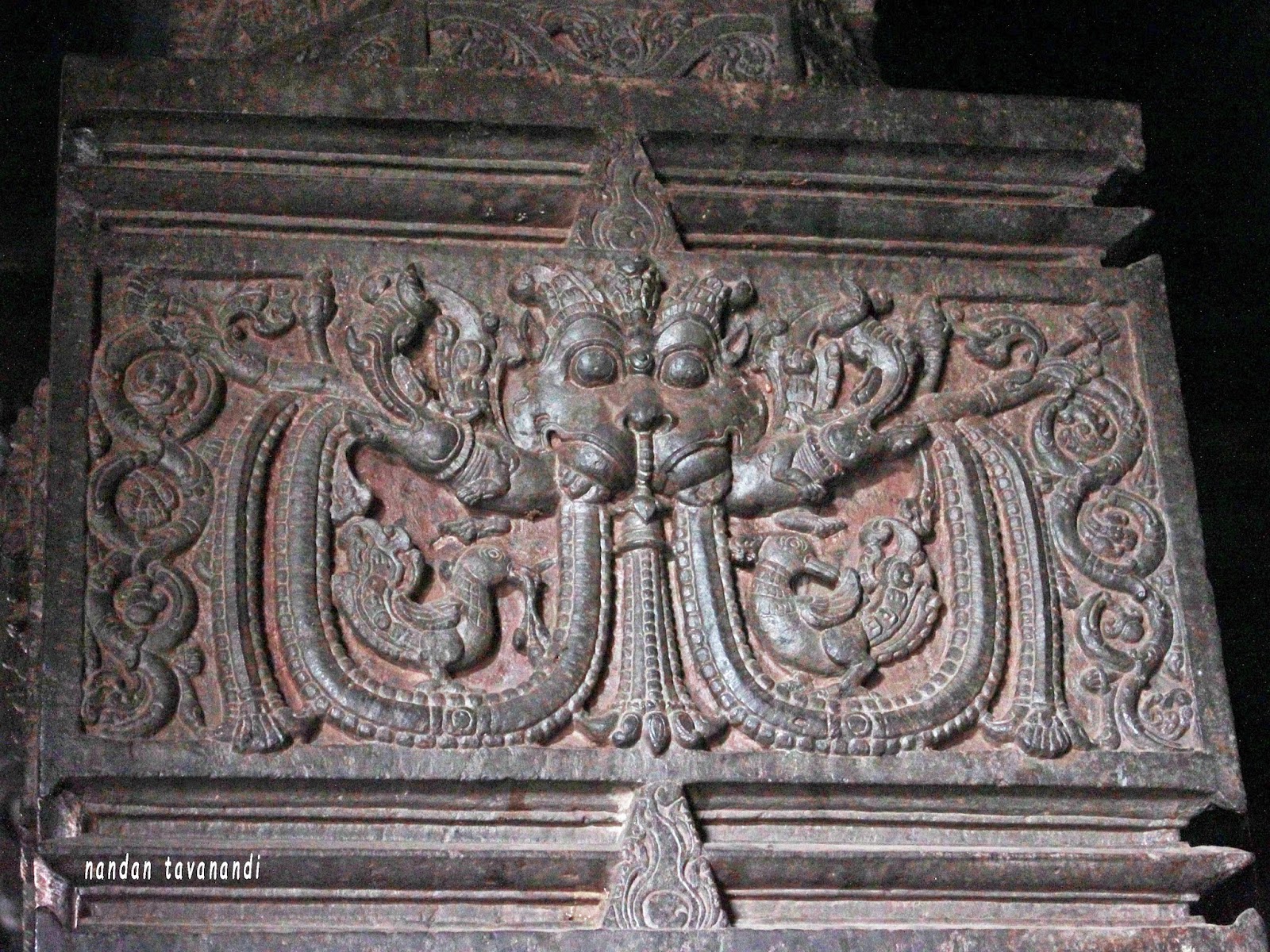
India has number of gems hidden in it small towns all over. When I looked on internet for places to visit around Kolhapur, Kopeshwar temple in Khidrapur was one place that caught my attention. There is good amount of information about it especially about its unique Swargamandap, presence of both Vishnu and Shiva in one temple, conspicuous absence of Nandi and its Hemadpanti architecture.

My first impression of the temple was its compactness compared to many other temples and temple ruins. This temple, though heavily desecrated, still retains its exquisiteness. More than the damage carried out in the history, what really hurt my eyes was the unprofessional restoration attempts by  our own present day experts using cheap building material. Some pictures clicked during my visit about an year ago :

A very nondescript looking entrance to the temple

The temple from its rear side

A visitor appreciating the stonework, unfortunately heavily damaged.


This temple is very conspicuous with its Swargamandap standing on 48 pillars and Rangasheela. The Swargamandap opens to sky through an opening of about 4 meter diameter. 


Tuesday, 18 February 2014

Three Tajmahals of Agra ...

My first memorable visit to Agra was with family in June 2012. There is more to Agra than just Tajmahal in fact 3 Tajmahals as the locals refer to them. More about the other 2 Tajmahals later in this Blog.


We had booked into a budget hotel just about 100M from Taj which had claimed on his website that their terrace and even some of the rooms offered a good view of Taj  The owner was right on both the counts and Taj was in fact just about 10 minutes walk.

Moghuls ruled India between 1526 and 1707 was the most and It lasted another 150 years after Aurangzeb’s death in 1707 (until almost the Indian revolution of 1857) but it did not have the same grandeur as before.

I did not find much variance in what I had read in the school history books and what the guide informed us about Taj that it took 22 years and 22000 labour force to build it. One of the internet site had even revealed that the project cost was approximately US $68000 !

On seeing these large monuments, I keep wondering about the weights involved and how the heavy load handling was managed during those days before the advent of cranes or similar equipment. Even after watching several documentaries on how pyramid like huge constructions were managed by the then experts, none if my questions are answered.

What I understood about the 2nd Tajmahal ..... Shahjahan, soon after the 'white marble' Tajmahal, had planned another one, but a black one - an exact replica of the marble one just opposite the original across river Yamuna as his own burial place. Shahjahan, it seems had even plans to connect the two Taj Mahals, white and the black with a beautifully decorated bridge. Unfortunately he couldn't complete his plans due to the war of succession with his son Aurangzeb.

We did visit the site of the Black Tajmahal where only some foundations are visible today and amongst these we even found a Redwattled Lapwing fiercely protecting her 3 eggs.

Let us come now to the third Taj of Agra known formally as Itmad-ud-Daula's Tomb but more popular as Mini or Baby Taj locally. Baby Taj was commissioned by Nur Jahan the wife of Jahangir for her father Mirza Ghiyas Beg who had been given the title of Itimad-ud-Daulah (pillar of the state). He was also the grandfather of Mumtāz Mahāl the wife of the emperor Shah Jahan.

The tomb, built between 1622 and 1628 represents a transition between the first phase of monumental Mughal architecture - primarily built from red sandstone with marble decorations, as in Humayun's Tomb in Delhi and Akbar's tomb in Sikandra - to its second phase, based on white marble and inlays most elegantly realized in the Taj Mahal.

Sunday, 16 February 2014

Frogner Park in Oslo, Norway

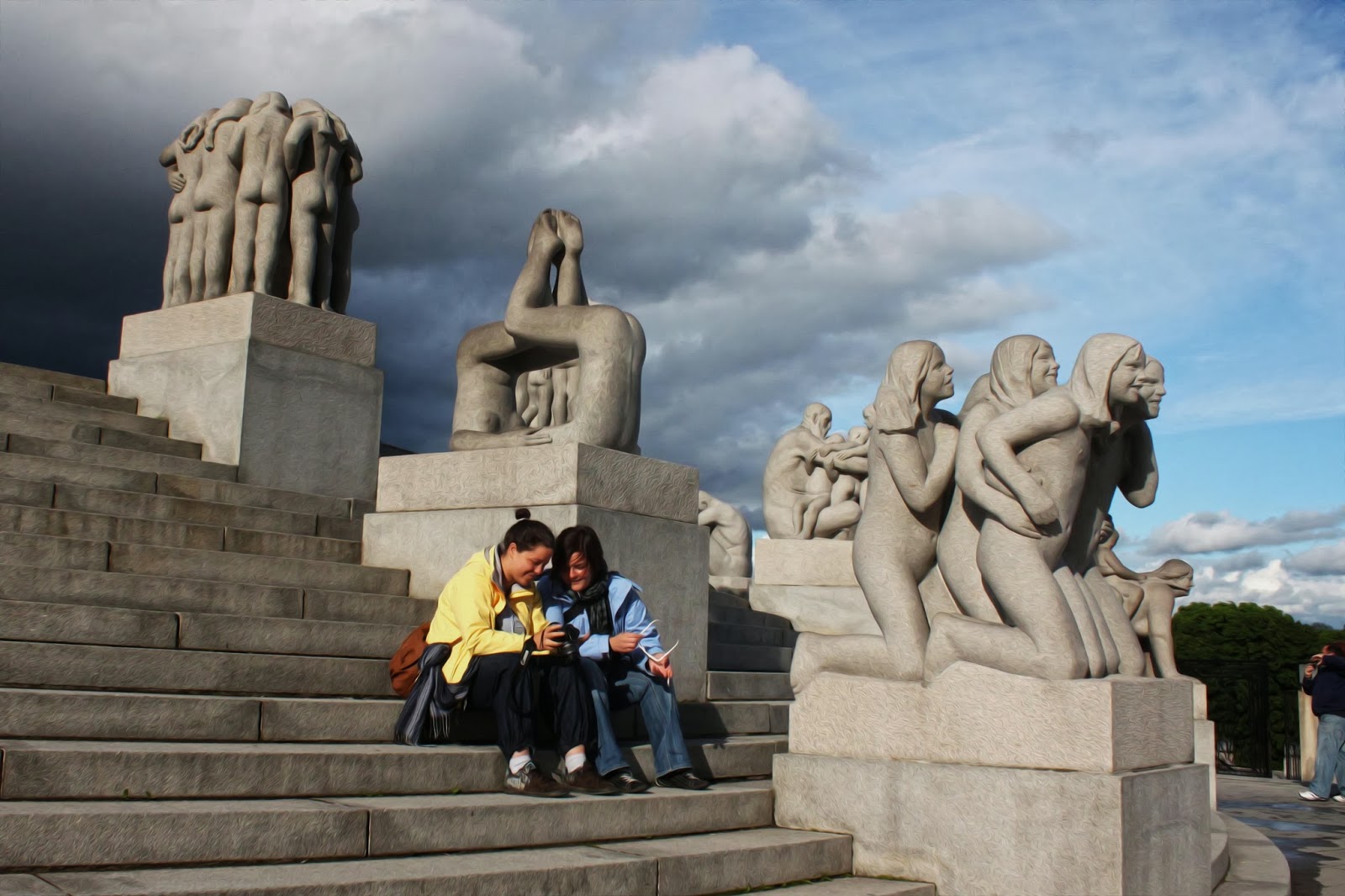
Frogner Park is a public park located in Oslo, Norway and historically a part of Frogner Manor. The Park contains sculpture installation created by Gustav Vigeland between the 1920s and 1943. It is the world's largest sculpture park made by a single artist.


Most of the statues depict people engaging in various typically human pursuits, such as running, wrestling, dancing, hugging, holding hands and so on.


However, occasionally one comes across statues that are more abstract, including one statue, which shows an adult male, fighting off a horde of babies.

But major attractions of the park is the Angry Boy and the Monolith in the west end of the Park.


The Monolith which is at the highest point of Frogner Park is another popular attraction. Construction of the massive monument began in 1924 when Gustav Vigeland himself modeled it out of clay in his studio in Frogner. The design process took him ten months. The model was then cast in plaster. A block of granite weighing several hundred tons was erected in the late 1920s and Vigeland’s plaster design was set up next to it to give reference to its sculptors. Transferring of the figures began in 1929 and took 3 stone carvers 14 years to accomplish. The Monolith was opened on the Christmas of 1944. The Monolith towers 14.12 meters (46.32 ft) high and is composed of 121 human figures.


The Monolith is meant to represent man’s desire to become closer with the spiritual and divine. It portrays a feeling of togetherness as the human figures embrace one another as they are carried toward salvation.

The Park also has several gates which are forged out of wrought iron.


And a few other sculptures :


Source : Wikipedia and other literature.

Monday, 15 April 2013

QUTAB Complex

Recently on my visit to the Capital, I had over an hour at my own disposal and Kutab Minar seemed to be the natural choice to spend time with, on my way towards the airport.

Qutab Minar is the tallest minaret in India made of red sandstone and marble. It is 72.5 metres (237.8 ft) high and has 379 stairs inside which reaches the top. It has a base diameter of 14.3 metres which narrows to 2.7 metres at the top storey. Construction was started in 1192 by Qutub-ud-din Aibak and was completed by Iltutmish. 

Kutab Minar pictures. some in black/white and some in colour.


It is so normal to look upwards towards these rising monuments as one walks around them and probably the first thoughts must be how did they manage to build these in that era !


This is how it looks as you look up ...


A classic view of the Minar that we see often in pictures . . .


The Iron Pillar located in Delhi (seen below along with the Qutab Minar), in the Qutub complex is another of the attractions notable for the corrosion-resistant composition of the metals used in its construction. Its origin is still not decided but said to be belonging to 'Candra' dynasty either Gupta King Candragupta II or Chandragupta Maurya based on the oldest inscription on the pillar which is in Sanskrit, written in Gupta-period Brahmi script referring to qualities of a king referred to simply as Candra.


The height of the pillar, from the top of its capital to the bottom of its base, is 23 ft 8 in (7.21 m), 3 ft 8 in (1.12 m) of which is below ground. Its bell pattern capital is 3 ft 6 in (1.07 m) in height, and its bulb-shaped base is 2 ft 4 in (0.71 m) high. The base rests on a grid of iron bars soldered with lead into the upper layer of the dressed stone pavement. The pillar's lower diameter is 16.4 in (420 mm), and its upper diameter 12.05 in (306 mm). It is estimated to weigh more than six tons.

Alauddin Khilji started building another minar : Alai Minaret as a tower of victory (seen below) in the same complex when he returned in triumph from his Deccan campaign. He conceived this tower to be two times higher than Qutb Minar but the construction was however abandoned, after the completion of the 24.5-metre-high (80 ft) first-storey core; soon after death of Ala-ud-din in 1316. 

Then there are other structures within Qutub Complex and one of them seemed to be a good resting place after a walk through the complex. The exquisite stone work in this place of about 10x10 meter structure with a dome on the top leaves every one wonderstruck.


The following gallery of pillars is from another area in the complex ...


As I was coming close to my time I remembered one of the quotes that I recently came across ... 'More you exlore, more there is'

The source of information in this blog is Wikipedia and I have to say it with a lot of gratitude.

I use it very often and I am amazed that it is being run purely on the donations received. What Wikipedia is about is best explained by its founder Jimmy Wales. It  is the #5 site on the web and serves 450 million different people every month – with billions of page views. What he has to say : " When I founded Wikipedia, I could have made it into a for-profit company with advertising banners but I decided to do something different. We’ve worked hard over the years to keep it lean and tight. We fulfil our mission efficiently.

Sunday, 10 March 2013

My Kumbh Experience


Life is all about faith. And it will be easy to understand what I say if one joins the millions who gather at Kumbh fair. 


This event of about 8 weeks taking place every 12 years at the confluence of 3 holy rivers in Allahabad attracts ascetics and devotees from all classes of society and all over the world. Streams of people from all directions were seen walking towards Triveni Sangam in Allahabad at that late hour, as I entered the city on the very night of Mauni Amavasya, the most auspicious of the days during Kumbh.

We are not new to crowd, be it railway stations or the daily office going crowd in metropolitan cities. But what was happening must surely be a 'one in 12 years' experience for me - as I with my friend began our walk next day morning towards Triveni Sangam, the meeting point of Ganga-Jamuna and the mythical Saraswati. 


Very soon we were inseparable part of the humanity that was moving as a single mass towards one destination. At one point of time on this 4 to 5 Km journey, the speed was such that I even wondered if we could return home by the sunset. But soon the crowd loosened and I dared to take a few clicks off my camera from a spot high enough to get a better feel of the crowd that was  .....


My purpose to be at Kumbh 2013 was just for an experience and be a part of one of the largest congregation on the face of earth but as we reached the waters, the atmosphere was so charged with 'Ganga maiyya ki jai' that it was natural for me to walk into the chilly waters and take that one holy dip the faithfuls believe would take them beyond the eternal life-cycle. 


Once through the holy dip, I began making my plans for the remaining time of the stay. On our return as we were making way through the crowd, my friend, a proud Illahabadi, had a lot  to share and while my ears were trained on him, my hands were busy clicking into the crowd.


It was nothing less than fascinating, the unending human flow, some carrying their baggage on head and  young ones on shoulders, and some even carrying their household effects wanting to set up their temporary homes on the banks of the holy river. It had to be the Faith that brought this huge number to this one place weathering all inconveniences in this chilly North Indian winter.  


All this only for a dip in the Holy river Ganga at the Sangam. Some, I was told, even settle for the whole period of about 8 weeks to take 3 dips every day.


Allahabad is a place of about 15 lacs (1.5 million) but on this auspicious day of Mauni Amavasya, over 30 million is said to have gathered in this one place if the TV reports were to be believed. It was difficult to fathom how could a city accommodates such a population even though for a short duration of a few hours or a day. As one drives around Allahabad the tents all over was a common sight. It was not very uncommon also to see families making any empty space their home for a few days under the open skies.


The arrangements that I saw throughout my 3 days in Allahabad were quite efficient considering the job on hand and the shear thought of controlling a sea of humanity and traffic like this was mind boggling. Bathing in the Ganges and rituals being at the center of this Mega Event, the administration this time had prepared 3 separate locations across the Sangam where the faithfuls were directed for their holy dip. The river was bridged at 22 locations temporarily with help of pontoon bridges, 7 of which are seen here :


When my good friend Ashok Kumar from Allahabad invited me for Kumbh about 4 months ahead of the event, I  did not think twice before saying yes and immediately had made my travel plans and bookings. Otherwise, it would have been impossible to reach and come out of the city so comfortably during this period.

Once I got my geography right about the Kumbh event on the day-one with help of my friend, I set out alone with my camera early next morning. here are some faces of Kumbh .....


With the main question of lodging solved by my dear friend Ashok Kumar, I was free to roam around in the Kumbh in somewhat carefree mind. And on arrival home after every tiring session, I used to be greeted first with Gajak a local sweet and a cup of hot tea and if the time was right then a meal with a new local delicacy cooked by his wife.  


Some information about Kumbh Mela gathered on Internet should be interesting and useful to the reader : 
It is believed in Hinduism that drops of nectar fell from the Kumbh (pitcher) carried by gods after the sea was churned. The festival is billed as the "world’s largest congregation of religious pilgrims, with over 30 million people expected to gather just on the one day of Mauni Amavasya, which I had chosen as my day of  arrival in the city.   
In my reading, I had come across certain sects of ascetics named Aghoribabas and Nagababas, both disciples of Shiva, the master of Yogis and symbol of death and destruction. Nagababas were said to walk about naked, symbolizing their renunciation of the world of mortals, rub their body with ashes of the holy fires, symbolic of death and rebirth. Where as Aghoribabas another obscure and small sect try to emulate the most extreme characteristics of Lord Shiva as the Conqueror of Death. They haunt cremation-grounds, bathe in cremation-ashes, wear garland of skulls and bones and Aghoris even said to willingly transgress all ascetic taboos eating meat and drinking alcohol.                                                               
Even more horrid habits attributed to Aghoris is that they eat the putrid flesh of corpses and follow many such 'aghori' practices.  It is questionable whether all this is regularly done, but it seems quite certain that at least occasionally these cannibalistic and other 'inhuman' acts were still taking place. 

I did not have suitable contacts to reach the Aghori camps but was fortunate enough to come across the tents of Nagababas . . .


On one of the evenings, another of my local friend Arun helped me and even joined me on a boat ride through river Yamuna and that was another memorable experience watching the bathers and the gathering from the other side ... 


And later that day Arun even took me around the city and I dedicate following 2 pictures to him ..... one taken of the Kumbh camp at night where the railway bridge across Ganges is seen in he background and the Kumbh settlement in the foreground.
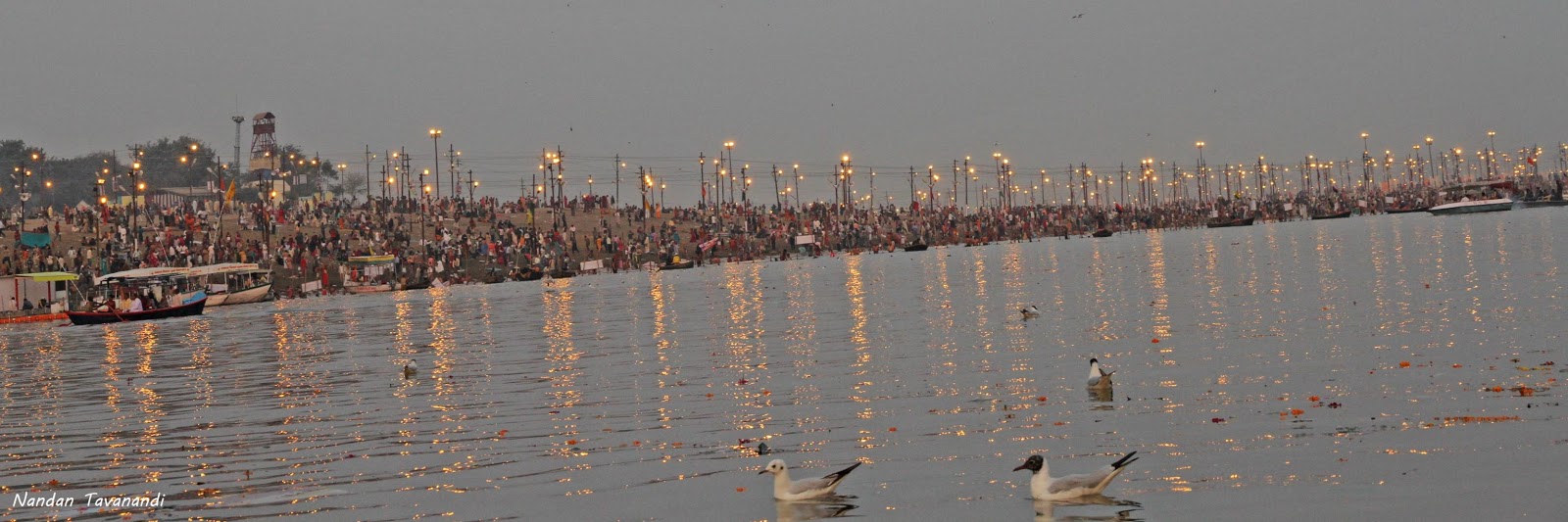
And ... this flock of gulls with the Kumbh lights in the background :

With my Kumbh experience coming to an end, I decided that I would be there at the next Kumbh in Haridwar 3 years from now. For understanding of the Kumbha calendar ... It is held every third year at one of the four places by rotation: HaridwarAllahabad (Prayag), Nasik and Ujjain. Thus the Kumbh Mela is held at each of these four places every twelfth year. The rivers at these four places are: the Ganges (Ganga) at Haridwar, the confluence (Sangam) of the Ganges, the Yamuna and the mythical Saraswati at Allahabad, the Godawari at Nasik, and the Kshipra at Ujjain. There is also 'Ardha Kumbh' held every 6 years at Allahabad and Haridwar.

Anyone joining me at the next Kumbh ?